Vous êtes ici

Vous Etes Ici

Bonjour tout le monde! We’ve had unbelievably good weather (if a bit chilly) since arriving in Paris two weeks ago, but today is rainy, so I’m trading my sneakers for slippers and catching up on the computer.

The social media silence is also due to my cell phone situation. Being an old-fashioned and irrational type, I resisted acquiring a European plan for my iPhone, insisting instead on using a dinky Nokia I purchased in London eight years ago. It is not a smart phone — more like a walky talky (or, “talkie-walkie,” as the French would say) — but it inspires great nostalgia and wonder amongst friends and strangers. I have no way to post pictures or pithy comments online in real time, and no Google maps to guide me, but I am alive. Post hoc ergo propter hoc?
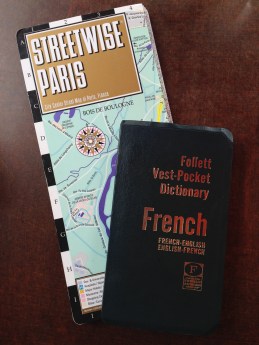
IMG_0380Armed with only an outdated French pocket dictionary care of my grandmother, and a glossy street map from a bookseller friend back home, I set out to find my fortune. It turns out there are many bookstores in Paris. In fact, there are so many, plus les bouquinistes, and markets, that it’s hard to know where to begin. So I took the train to Lille.

Once a year, in this town just south of the Belgian border, thousands of vendors and millions of visitors converge for one weekend at “the biggest flea market in the world.” I had read about the Braderie last Friday in the morning newspaper distributed in the metro. My French is pas tres bien, but I understood enough to know it was THE PLACE TO BE. I ran to catch a train from Gare du Nord for the opening on Saturday.

The Lilliputians aren’t kidding around. It took an hour to navigate from the Lille Flandres train station to my hotel in the city center; not because I couldn’t access Google maps, but because of the throngs of scouting, peddling, pushing crowds. When I finally parked my belongings in my tiny room with impossible curtains and a stubborn lock, I had to lie down for ten minutes. The U.S. Open was on TV, but the French cameraman had focused at such an angle that the ball was never visible. I gathered my wallet, my phones, and my strength, and ventured outside.
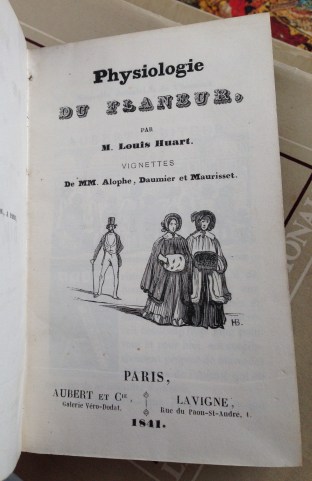
Physiologie du FlaneurThe bookstands were few and far between. Literally, there were many kilometers of vendors. I was distracted, respectively, by sizzling waffles, vintage sherpa coats, and Euro-emblazoned underwear, while looking for the main event. I found it on a little side street near the Port de Paris: two professional booksellers, set up back-to-back, far from the madding crowd. Cautious as usual, I didn’t spend hundreds of Euros on the spot, but I took their business cards and promised in my best French to be in touch about a few titles.

I did buy a book in the designated paper and book showcase lining La Vieille Bourse; I couldn’t resist the cover art on a dictionary of dreams for 5 Euro (interesting subject, too). I also found a stockpile of cartes postales at the stand of a paper dealer near the Parc Jean-Baptiste Lebas. I’ve always loved old pictures, especially black-and-white booklets of postcards with images of locals milling around famous sites. Not the bulky albums with individual cards inserted, but the self-contained, site-specific booklets.

Odd spine stampsOn a codicological note, I spotted some intriguing anomalies, including this test (?) spine (left), gilt-stamped all over in multiple directions. More discoveries pictured below.

Yoga Book

Yoga book from 1955.

Travel Scrapbook

Scrapbook documenting a couple’s trip to Switzerland with their tickets and souvenirs.
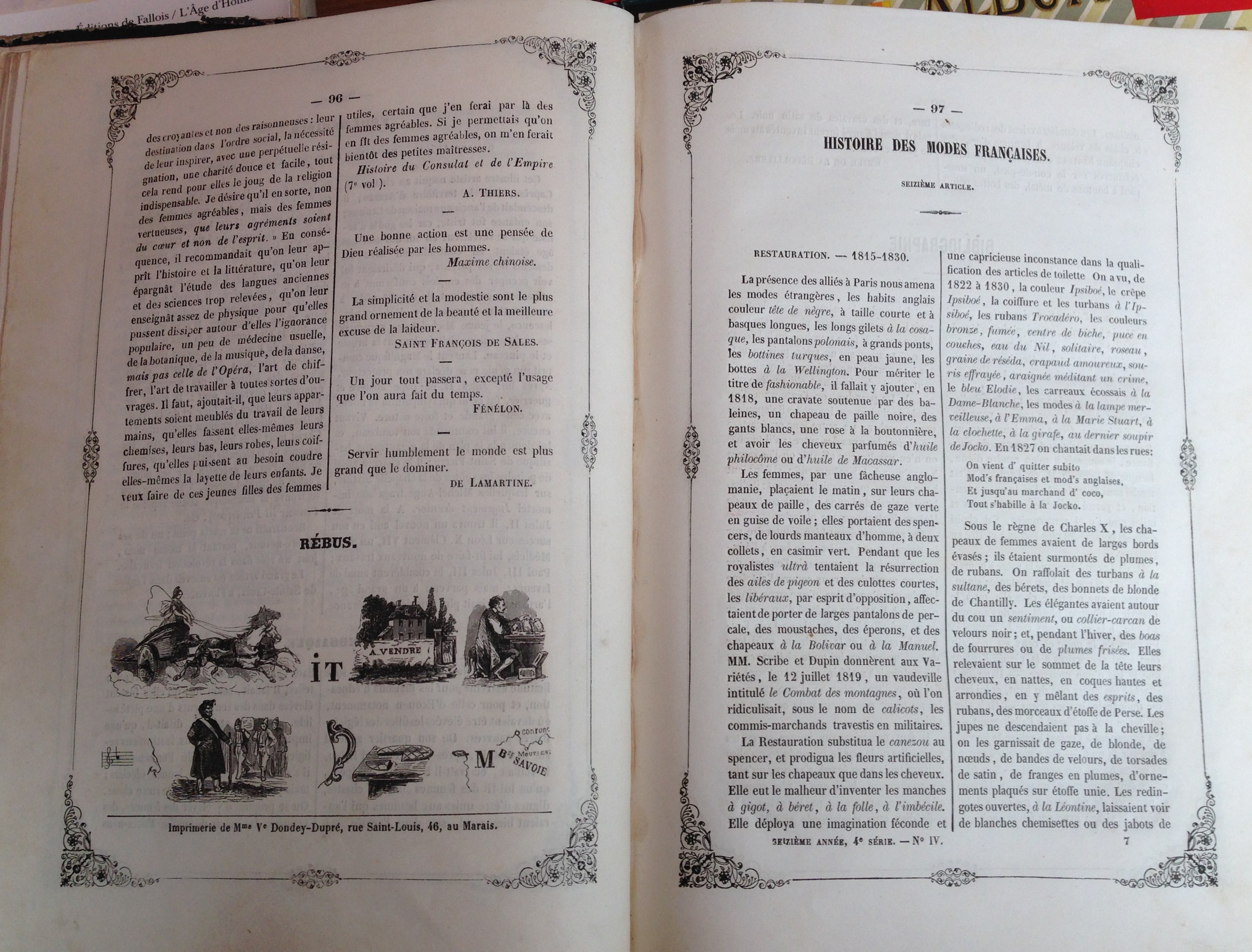
Rebus

One of many rebuses punctuating the text of this periodical.

Flea Models

Participants in the Braderie de Lille.

Opera lenses

Opera lenses wrapped in hand-dated papers.

Shop Window with Books

Clothing store or library?

Back home in Paris, la rentrée means fashion week is soon upon us. Books and Brooklyn are the prevailing themes this year. Le Bon Marché, arbiter of style, issued an entire catalogue of Brooklyn-chic clothing and housewares, including sets of glasses from Fishs Eddy selling at a whopping 45 Euro, if I remember correctly. (The catalogue was an insert in a magazine, which, alas, I have since recycled via the very particular French system of multi-colored garbage bins all destined for the same heap). In fact, the department store is currently holding an entire Brooklyn Rive Gauche sale. Meanwhile, Saint-Germain shop windows are filled with stacks of books and brooding models in loose tweeds. If not for the language barrier, you’d think we were locals, non?

Posted in Books, Flea Markets, Paper, Paris, Travel | Tagged , , , , , | 6 Comments

Firsts

Soon I’ll be in Paris, blogging about books and adventures abroad. For my first post, however, here’s a review I wrote in New York City, shortly after returning from the Colorado Antiquarian Book Seminar in Colorado Springs…

On the first day of the Colorado Antiquarian Book Seminar, Terry Belanger stood solemnly in front of our class and commanded us to “follow the rulebook with supine acquiescence.” We were feverishly scribbling collational formulae in our notebooks as he added, “The fact that it is ridiculous is totally irrelevant.” The group let out a communal chuckle and went on copying the ever-expanding equations projected on the wall.

Terry was referring specifically to the Ur-text of bibliography by Fredson Bowers, a rulebook every cataloguer knows and loves to bemoan; but the general idea of “following the rules” served us well throughout the week. The CABS faculty, all authorities on books and bookselling, gave us many rules to work and live by, including: hone in on and own your specialty, find your voice, and identify your ideal customer. Inherent in these directions is the notion that bookselling is an individualistic endeavor; every bookseller has her own way of doing things that may not work for the next guy. Some rules, however, apply across the board, regardless of personal modus operandi: be patient, don’t be a jerk, always look at books closely, and sell, sell, sell.

An economist might envision the CABS microcosm teeming with competitive species chasing the same prey. Au contraire! Booksellers are the first to tell you that each one of us has a niche and our diversity keeps the community alive. Common interest in books unites rather than divides us, or “Amor librorum nos unit,” as the ABAA motto reads. This at least partially explains the astonishing generosity of the CABS faculty, who put their lives on pause for a week to teach potential “competitors” tricks of the trade; and accounts for the twelve separate scholarship funds for CABS students. I received an ABAA scholarship to attend, and will do my very best to pay it forward.

In my childhood home we had a coffee mug with a Far Side cartoon of a frazzled scientist pointing at a formula on a blackboard above the caption, “Einstein discovers that time is actually money.” This revelation won’t be news to any bookseller, but it has new meaning for me as I find myself with more time than money, i.e., being self-employed. No amount of work experience – assisting some of the best dealers in the trade – adequately prepares you for being your own boss. Osmosis only gets you so far. CABS is the missing piece, a boot camp for like-minded people communicating in the same specialized language and helping each other achieve success.

It’s no wonder that dealers at the head of thriving businesses still flock to Colorado Springs for a week of intensive study and conversation with colleagues from across the globe (there was a particularly large contingent of Australians, some of the nicest people I’ve ever met). At CABS, you can ask any question on the subject of books and receive thoughtful answers from some of the greatest minds in the “bibliomundo,” as my classmate Cynthy Buffington calls the community of booksellers, -collectors, and -preservers. There is always more to learn, and adaptability behooves us all.

This year’s guest speakers were Katherine Reagan, Curator of Rare Books and Manuscripts at Cornell, home of the nation’s premier Hip Hop Collection; and Garrett Scott, dealer in obscurities with a focus on “books and pamphlets on dead-end byways of American thought,” including the topics Utopia, doom, sex, and “old weird America.”

Boring, right?

Katherine’s keynote address on “Why Curators Love Booksellers” set a collegial, humorous tone for the week while imparting valuable advice on building relationships with librarians. She also reminded us that scholarship drives institutional collecting, so booksellers should stay attuned to changing tastes. Although Hip Hop culture may not appeal to everyone, no one can honestly deny its cultural significance.

Garrett’s mid-week talk, peppered with slides and anecdotes, made us all grateful to be in the same profession, which he likened to the D.I.T.C. (“Digging in the Crates Crew,” a New York Hip Hop group that made its name sampling old records). Booksellers like Garrett constantly “remix” old material in new ways. As Katherine suggested a couple of days earlier, this might be the best approach ever to long term success in the book business. Our mission as booksellers, should we choose to accept it, is to “rescue forgotten voices,” and retell their stories in such a way as to “make the buyer feel the same emotion you did when you bought the thing” (Garrett). More than one of us cried tears of joy during Garrett’s inspirational, aspirational description of his personal philosophy. I even overheard an esteemed librarian wondering, briefly, why he ever switched sides.

We’ve all heard the old adage, “You must have the cheapest copy, best copy, or only copy” (Bill Reese, et al.). Here’s an additional sampling of pithy advice from the week in Colorado: “Don’t trust, do verify” (Nina Musinsky), “Independence is everything” (Sally Burdon), “Make lists” (Dan DeSimone), and “Don’t mess with the archive” (Steve Smith). Sadly, Nina, Sally, Dan, and Steve all surrendered their CABS lanyards this year. Who can imagine the week without their bonhomie, not to mention Nina’s expertise on early books; Sally’s marketing strategies; Dan’s firsthand tips on selling to libraries; and Steve’s inside scoop on acquisition policy? It’s clear from their rapport in and outside the classroom that the CABS teachers enjoy the seminar just as much as the students, and the four departing faculty will be missed terribly by everyone. Listening to them and Lorne Bair, Brian Cassidy, Terry Belanger, and Rob Rulon-Miller talking shop, you got a sense not only of the group’s command of the book business, but also of their camaraderie, built over time and transactions.

On the last day of CABS many students expressed that they would have difficulty describing the week to people back home. At the closing dinner, John Bell was inspired by his conversation with Lorne to ascend the podium and read “Poetic Terrorism,” by Hakim Bey. “Pick someone at random & convince them they’re the heir to an enormous, useless & amazing fortune…,” he implored. “[They] will perhaps be driven as a result to seek out some more intense mode of existence.” There couldn’t have been a more fitting end to the week. Graduates of CABS share in a vast sum of knowledge and friendship that will enhance both our careers and our lives.

Posted in Uncategorized | 2 Comments